

O tax planning is one of the smartest strategies for companies wishing to reduce their tax burden, avoid fines and ensure compliance with the tax authorities.
More than simply paying taxes, planning allows the entrepreneur to pay fair value, using current legislation to your advantage.
But what is tax planning in practice? How can it impact your company's performance? And what are the steps to implementing it efficiently?
In this article, you will understand how tax planning works, what the main benefits are and how to apply this practice safely and strategically with the support of CLM Controller Accounting.
What is tax planning?
Tax planning is the set of legal strategies used by a company to organize your tax activity with the aim of paying less tax safely and within the law.
Unlike tax evasion, which consists of the omission of information and is a crime, tax planning is a crime. totally legal practice, which is provided for in Brazilian law, and aims to optimize tax payments, making the most of it:
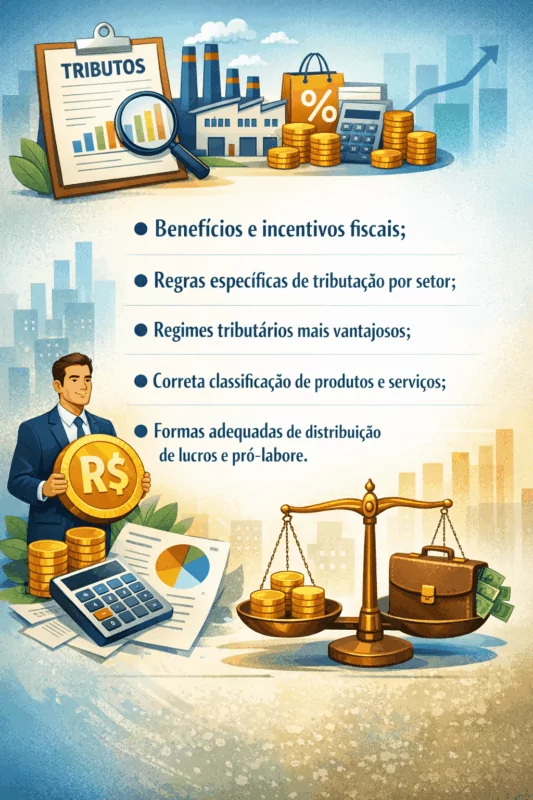
In short, the aim is to pay only what is necessary, based on the best reading of the company's reality and the applicable legislation.
Why is tax planning important?
Brazil has a complex tax system, with various federal, state and municipal taxes. Each regime (Simples Nacional, Presumed Profit, Real Profit) has its rules, limits, rates and obligations.
Companies that don't bother with tax planning run serious risks:
- Paying more tax than they should;
- Choosing an inappropriate tax regime;
- Failing to take advantage of tax benefits;
- Being fined for errors in calculating taxes;
- Financial losses due to poor tax management.
Those who plan well, however, succeed:
- Legally reducing the tax burden;
- Increasing competitiveness;
- Improve cash flow;
- Avoid assessments and fines;
- Make smarter and safer decisions.

Tax outsourcing
The strategic solution for companies
When to do tax planning?
Tax planning is ideal:
- At the beginning of each calendar year, to choose or confirm the best tax regime;
- Before starting a business, considering the size, CNAE and corporate structure;
- Whenever there are changes in the company's turnover, activities or structure;
- When planning expansion into new cities or states, These include new taxes or local legislation;
- Before opening branches or changing the corporate structure of the business.
In addition, tax planning must be periodically reviewed, This includes monitoring changes in legislation, tax rates, ancillary obligations and possible regional or sectoral incentives.
For tax planning to be efficient and secure, it must follow a series of well-defined steps. See step by step:
1. Company tax diagnosis
The first step is to survey and analyze:
- Monthly and annual billing;
- Fixed and variable costs;
- Current tax system;
- Economic activities (CNAEs);
- How taxes are calculated (cumulative or non-cumulative);
- Accessory obligations and their operating costs.
This stage is essential for understanding the company's fiscal situation and identifying where the bottlenecks and opportunities lie.
2. Choosing the ideal tax regime
Based on the data collected, the accountant assesses which system is most advantageous:
- Simples NacionalCan be used by micro and small companies with a turnover of up to R$ 4.8 million/year;
- Presumed ProfitCan be used by companies with revenues of up to R$ 78 million/year and stable margins;
- Real ProfitMandatory for some activities and companies with revenues above R$ 78 million, or advantageous when actual profits are low.
The wrong choice could mean thousands of reais lost in taxes, This is why it must be done with great care.




3. Analysis of tax incentives
Brazilian legislation allows various tax incentives sectoral, regional and federal. Some examples include:
- Reduction or exemption from ICMS for strategic sectors;
- Incentives for exporters;
- Tax benefits for technology companies (Lei do Bem);
- Special regimes for builders and developers (RET);
- IRPJ deductions based on investments in culture, sport and innovation.
Good tax planning checks which of these benefits can be used legally by the company.
4. Corporate and operational restructuring
Often, the way a company is organized can have an impact on the tax burden. Planning can include:
- Reduction of pro-labore to increase exempt profit distribution;
- Creation of a holding company to organize assets and succession;
- Change or addition of CNAEs to fit into lower tax rates;
- Change of PIS and COFINS calculation system (cumulative or non-cumulative).
These decisions should always be guided by an experienced accountant.

Get to know our
Corporate Planning
5. Implementation and continuous monitoring
After planning, it's time to implement the changes and monitor the results. This includes:
- Review of tax and accounting routines;
- Correct issue of invoices;
- Monthly tax assessment;
- Sending accessory obligations;
- Monitoring legal changes that may affect planning.
Fiscal management is continuous and requires monitoring and periodic corrections.
Common mistakes in tax planning
Even with good intentions, many companies make mistakes that compromise the tax planningsuch as:
- Choosing a tax regime based only on tax rates, without considering profit margins and payroll;
- Failing to update planning after changes in billing;
- Using incorrect tax classifications (NCM, CNAE, CFOP);
- Mixing personal and company finances;
- Not having the support of a specialized accountant.
These errors can result in undue payment of taxes, assessments, fines and financial losses.
Tax planning and the Tax Reform
With the approval of the Tax reform, Tax planning, which will come into force gradually until 2033, will be even more important.
The changes involve:
- Substitution of PIS and COFINS by CBS;
- Creation of the IBS (state and municipal tax);
- New Dual VAT, with transitional rules;
- Changes to the way taxes are paid and calculated;
- New criteria for tax credits and offsets.
Companies that anticipate their preparation and adjust their tax planning now, they will have competitive advantage and more legal certainty.
Listen to our podcast and find out about all the changes in the Tax Reform.
How can CLM Controller help your company?
A CLM Controller Accounting specializes in strategic tax planning for companies of all sizes.
We work with a focus on reducing tax burdens, legal compliance and financial optimization, always in a personalized and transparent manner.
The services we offer include
- Complete tax and accounting diagnostics;
- Tax regime simulations;
- Structuring holding companies and corporate reorganization;
- Tax review and recovery of tax credits;
- Continuous follow-up with advisory support.
Do you want to pay less tax legally and safely?