




LCI and LCA are fixed-income securities issued by financial institutions and historically known for Income Tax Exemption for individuals.
With the new tax proposal set to take effect in 2026, many investors want to understand what will change in practice, how this will affect returns, and whether these securities are still worth investing in.
In addition to being conservative options within the fixed-income market, LCI and LCA securities tend to attract business owners and investors seeking returns backed by the Credit Guarantee Fund and with a lower tax burden.
The question now is how these products will fare under the new 5% tax proposed for securities that are currently exempt.
In this guide, you will understand what LCI and LCA are, how they work, what their advantages and limitations are, what will change with the new taxation in 2026 and how to compare these investments with alternatives such as CDB and savings accounts.
Quick summary: what changes with LCI and LCA in 2026
If you're in a hurry, here's the gist:
LCI provides financing for the real estate sector; LCA provides financing for agribusiness. Currently, income from these instruments is exempt from income tax for individuals. The proposal for 2026 calls for a 5% tax on such income.
Even with taxes, LCI and LCA bonds can still remain competitive. For corporations, these bonds no longer offer the same tax advantages as they do for individuals.
What are LCI and LCA?
LCI stands for Letra de Crédito Imobiliário and LCA for Letra de Crédito do Agronegócio. Both are fixed-income securities issued by banks and other financial institutions to raise funds that will be directed to specific sectors of the economy.
With an LCI, the funds are used for real estate financing. With an LCA, the funds raised are used for agribusiness-related operations. From an investor’s perspective, the two work very similarly: you lend money to the financial institution and receive interest in return.
These securities are often compared to CDBs because they are also part of bank fixed income. The major historical difference has always been the exemption from income tax for individuals, a factor that has helped make LCIs and LCAs very attractive in various market scenarios.
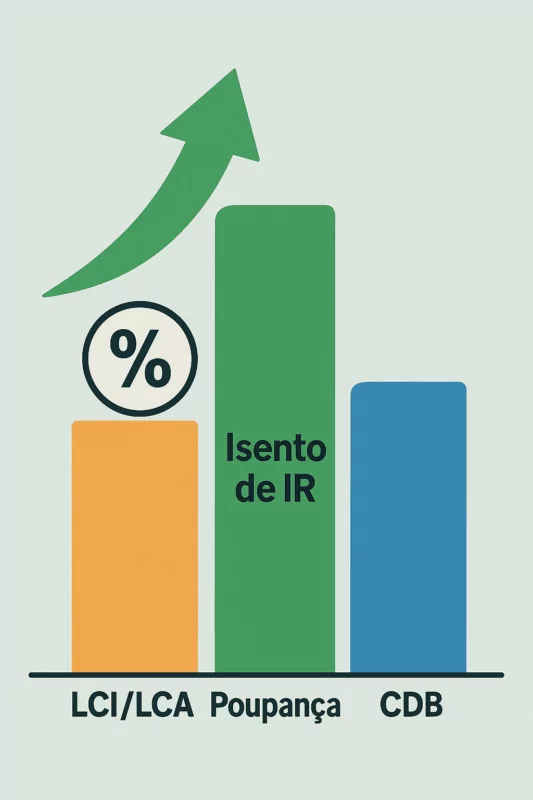
These securities are often compared to CDBs because they are also part of bank fixed income. The major historical difference has always been the exemption from income tax for individuals, a factor that has helped make LCIs and LCAs very attractive in various market scenarios.


Complete Guide:
LCI and LCA made easy:
How does it work in practice?
When you invest in an LCI or LCA, you invest funds for a specified period and receive a return that can be fixed, floating, or hybrid. In many offerings, the rate is linked to the CDI, such as 90%, 95%, or 100% of the CDI.
In practice, the bank uses the funds it raises to finance operations related to the real estate or agribusiness sectors and pays you interest at the agreed-upon rate. In return, you must adhere to the product’s term and, in many cases, the grace period before redemption.
Example:
If an LCI pays 95% of the CDI and the CDI is around 13% per year, the approximate gross return would be 12.35% per year. For individuals, this yield has historically been net of income tax under the current rules.
LCI and LCA are covered by the Credit Guarantee Fund, in accordance with the limits in effect per financial institution and per CPF. This feature enhances the perception of security associated with these fixed-income products.
Advantages and disadvantages of LCI/LCA
Advantages
- Income Tax Exemption for Individuals Under Current Rules;
- Protection of the Credit Guarantee Fund within the current limits;
- Generally low risk compared to more volatile investments;
- Returns that are often competitive with CDBs and savings accounts;
- A good option for building a reserve or a conservative portfolio with a fixed term.
Disadvantages
- Lower liquidity than that of products with daily redemptions;
- The need to comply with a grace period or due date;
- The nominal rate does not always exceed attractive offers on taxable CDBs;
- Reduced tax benefit for corporations;
- Under the new tax system, net income is likely to decline compared to the current model.

Compare PF vs. PJ
with tax on dividends
Are LCI and LCA still worth it?
In many cases, yes. Even with the proposed taxation of 5% from 2026, LCI and LCA can still be good options for investors looking for security and competitive net returns.
The decision depends on the rates offered at the time of application, the term, liquidity and comparison with other fixed income products. An exempt bond always has a significant advantage over taxed products, and even with reduced tax this difference can continue to exist in various scenarios.
Do you have any questions about the taxation of profits? Talk to us
Taxation of 5% from 2026: what changes in practice
The main change proposed is the end of the total exemption for individuals in these securities. As of 2026, the idea is to apply a 5% rate on income from LCIs and LCAs, as well as other securities that are currently considered incentive bonds.
This means you will no longer receive 100% of net income. Even so, the proposed tax rate is much lower than that applied to traditional fixed-income investments, which follow a regressive tax schedule and may be taxed at rates ranging from 15% to 22.5%, depending on the term.
Here is a summary of the change:
Previously: full exemption for individuals. Starting in 2026: proposed 5% income tax on earnings. Practical effect: a reduction in the advantage, but not a loss of competitiveness.
Therefore, the real impact will depend on the contracted rate and the comparison with other products available on the market at the time of the decision.
Individuals vs. legal entities: what entrepreneurs need to know
An important point for entrepreneurs is that the tax advantage of LCI and LCA has always been more relevant for individuals. For legal entities, these securities don't have the same tax benefits and are usually treated in the same way as other fixed-income investments.
This means that many businesspeople evaluate LCIs and LCAs mainly for individuals, while for the company's cash flow the comparison usually needs to consider other investment alternatives, liquidity and taxation.
The correct analysis varies significantly depending on who the investor is: an individual investor or a corporate entity.
LCI and LCA vs. CDB and savings account
Product | PF Taxation | Liquidity | Observation |
LCI/LCA | Exempt today; proposed 5% in 2026 | Usually smaller | Good relationship between security and net profitability |
CDB | Regressive income tax table | Can have daily liquidity | Flexible, but subject to higher taxation |
Savings | Exempt | High | Lower profitability in many scenarios |
This comparison shows why LCI and LCA are still relevant: they occupy a very interesting middle ground between security, yield and simplicity. Even with the new taxation, the analysis needs to be based on the final net return.

How to assess whether this investment makes sense
Compare the interest rate offered with CDBs and other fixed-income alternatives; note the grace period and maturity date of the security; analyze the difference between investing as an individual and as a corporation; consider how the 2026 tax change will affect your net return; avoid making a decision based solely on the tax exemption or the product’s name.
This analysis is especially important for entrepreneurs seeking greater efficiency in cash management and the temporary allocation of resources.
Compare PF vs. PJ
with tax on dividends
How CLM Controller can help your company
Making sound financial decisions—whether to invest the company’s money in a tax-efficient manner or to plan your personal investments as a business owner—can make a big difference in your results.
A CLM Controller We partner with business owners in this process. With over 40 years of experience serving companies of all sizes, we offer high-quality accounting, tax, financial, and labor consulting services.
Our team provides consulting services, helping to better structure the business’s financial management and allocate resources with tax efficiency in mind, always focusing on controlling and optimizing results.
If you want to understand in detail how taxes affect your corporate and personal investments, find the best way to invest your company’s idle capital, or simply feel more confident in your financial decisions, you can count on the support of CLM Controller.
We are ready to help you develop a solid financial strategy that combines profitability with tax compliance, driving the sustainable growth of your business.
Get in touch with the CLM Controller and discover how our accounting and consulting services can add value to your company’s financial management, giving you peace of mind and efficiency so you can focus on what matters most: the success of your business.

Upgrade your finances:
Talk to us!
Frequently asked questions about LCI and LCA
It depends on the product and the terms of the contract. Many LCI and LCA accounts have a lock-in period, which means you cannot redeem your investment before a minimum period (usually 90 days to 1 year) without losing interest. If you try to redeem during the lock-in period, the bank will return only the amount you invested, with no interest. After the lock-in period, you can redeem your investment, but you may receive reduced interest or interest proportional to the time your money was invested. Not all securities allow early redemption—some only release the funds at maturity. Therefore, it’s important to check the specific terms before investing.
Yes, and that’s a smart strategy. The FGC covers up to R$ 250,000 per CPF at each financial institution. This means that if you invest R$ 250,000 in LCI at Bank A and R$ 250,000 in LCA at Bank B, both are fully protected. You can spread your investments across multiple banks to increase your total coverage. But be careful: if you invest R$ 300 mil in LCI at the same bank, only R$ 250 mil will be protected—the rest is unprotected. The tip is not to concentrate too much money in a single institution.
The FGC is a fund created by banks to protect investors in the event of a financial institution’s bankruptcy or liquidation. It covers up to R$ 250,000 per CPF per institution. This applies to LCI, LCA, CDB, and other deposits. If the bank goes bankrupt, the FGC will reimburse you up to this limit. Coverage is automatic—you don’t need to do anything other than have your money invested. Important: The limit applies per CPF and per bank, not per type of investment. So if you have R$ 150 mil in LCI and R$ 150 mil in CDB at the same bank, you’re protected up to R$ 250 mil in total, not R$ 300 mil.
With a fixed-rate loan, you know exactly how much you’ll receive at maturity—the rate is set when you take out the loan. If you take out a loan at 12% per year, you’ll receive exactly that amount, regardless of what happens to market interest rates.
With a floating-rate bond, the yield is tied to an index, usually the CDI. You receive a percentage of the CDI (such as 90% or 100%), and the final amount depends on how the CDI performs during the term. If the CDI rises, you earn more; if it falls, you earn less.
In a hybrid rate, it combines both: one part is fixed upfront and the other is floating. For example, 8% fixed upfront + 50% from the CDI.
Which is better right now? That depends on your expectations regarding interest rates. If you think rates will fall, a fixed-rate loan is better—you lock in a high rate. If you think they’ll rise, a variable-rate loan is more attractive—you take advantage of the increases. In uncertain scenarios, a hybrid option offers a balance. The best approach is to analyze the rates currently on offer and compare them with market expectations.
You cannot transfer the security itself. LCI and LCA are bank-specific securities and cannot be transferred to another institution. What you can do is redeem the investment (if allowed and without penalties) and invest the money in a new LCI or LCA at another bank with a better rate. But be careful about the lock-in period: if you redeem before the minimum term, you may lose the interest. The best strategy is to carefully evaluate the rates before investing and, for future investments, always seek out the best terms available on the market.
