

Reducing taxes for Real Profit companies is one of the most important strategies for businesses that already have a larger structure, significant turnover or better margins.
Despite being considered a more complex system, the Real Profit system offers unique opportunities for tax savings, as long as it is well managed.
Many companies see the Real Profit system only as a mandatory or bureaucratic regime, but the truth is that it can be extremely advantageous when used strategically. The problem is that, without planning, the company can end up paying more tax than it should.
In this article, you will understand how to reduce taxes for Real Profit companies, and how to turn tax management into a competitive advantage.
Understand how Real Profit works and why it can be advantageous
To achieve reducing taxes for Real Profit companies, The first step is to understand how this system works in practice.
Unlike Presumed Profit, In the Real Profit system, taxes are calculated on the basis of a predefined margin. effective company profit.
This means
- If the company makes less profit, it pays less tax
- If the company makes a loss, it may not pay IRPJ and CSLL
- Operating expenses can reduce the tax base
The main taxes in this regime are
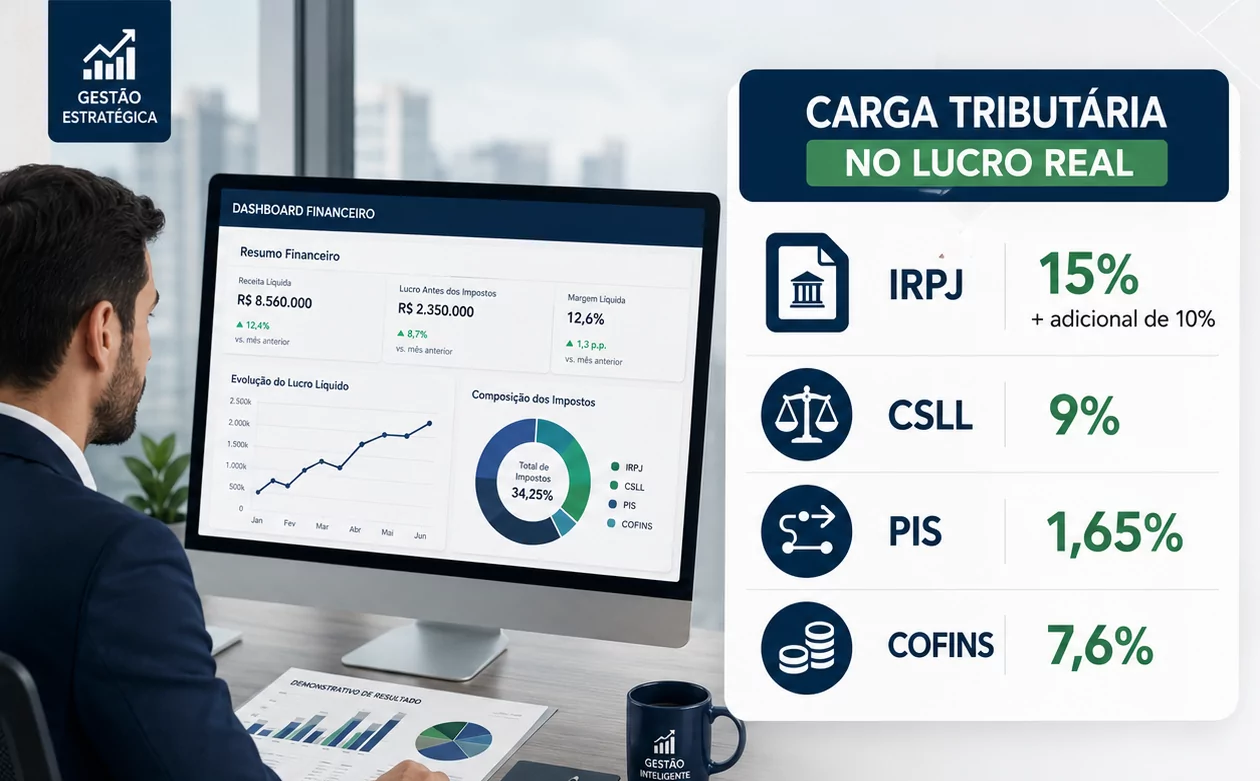
- IRPJ (15% + additional 10%)
- CSLL (9%)
- PIS (1,65%)
- COFINS (7.6%)
The great advantage lies in the possibility of deducting expenses and taking advantage of credits, especially in the case of PIS and COFINS.
Companies with lower margins, high costs or that invest a lot tend to benefit more from this regime.
In addition, Real Profit allows for greater financial and accounting control, which facilitates strategic decision-making.
However, the complexity is greater, requiring constant monitoring and well-structured accounting.
Tax planning: the main strategy for reducing taxes
If there is one decisive factor for reducing taxes for Real Profit companies, This factor is the tax planning.
In Real Profit, every operational decision can have a direct impact on the tax burden. This means that planning needs to be continuous and integrated into the company's operations.
The main strategies include:
- Constant review of deductible expenses
- Cost structure analysis
- Investment planning
- Adjusting operations to optimize credits
For example, properly recorded operating expenses reduce taxable income, reducing the amount of IRPJ and CSLL.
Another important point is the timing of income and expenses. Anticipating or postponing certain events can have an impact on the tax result.
In addition, planning makes it possible to simulate scenarios and make more strategic decisions, avoiding surprises at the end of the period.
Companies that don't plan end up reacting to taxes, while those that do can anticipate and reduce the tax burden.
In Real Profit, the difference between paying too much or paying too little is directly linked to the quality of the planning.

Tax outsourcing
The strategic solution for companies
Use of PIS and COFINS credits
One of the biggest opportunities for reducing taxes for Real Profit companies is the use of PIS and COFINS credits.
In this regime, these taxes follow the non-cumulative model, allowing the company to use credits on various costs and expenses.
Among the main items that can generate credits are:
- Purchase of inputs
- Electricity
- Rental of real estate used in the activity
- Contracted services
- Depreciation of assets
The problem is that many companies don't take advantage of all the possible credits, either due to a lack of knowledge or faulty accounting classifications.
This means they pay more tax than necessary.
Optimizing this process is essential:
- Identify inputs correctly
- Classify expenses appropriately
- Periodically review credits
- Use integrated control systems
Another important point is that the concept of input can vary depending on the company's activity, which requires technical analysis.
When properly applied, the use of credits can generate significant savings and improve cash flow.
Efficient management of expenses and costs
In Real Profit, expense management is one of the pillars for reducing taxes for Real Profit companies.
This is because operating expenses have a direct impact on taxable income. The greater the control and correct classification of these expenses, the lower the tax burden tends to be.
However, it's not enough just to have expenses - you need them:
- Necessary for the activity
- Proven
- Registered correctly
Undocumented or incorrectly classified expenses can be disregarded by the IRS, increasing the tax due.
In addition, good cost management makes it possible to identify savings opportunities and improve operational efficiency.
Another important point is the control of provisions and accounting adjustments, which also have an impact on the result.
Companies that have detailed financial control succeed:
- Reducing waste
- Improving margins
- Optimizing the tax burden
Integration between the finance and accounting areas is essential to ensure that all information is used strategically.

Corporate structure and profit distribution
Another important factor for reducing taxes for Real Profit companies is the way the company is structured and how it distributes its profits.
A distribution of profits, When done correctly, it can be exempt from income tax for the partners. However, this requires:
- Regular bookkeeping
- Consistent income statement
- Compliance with tax obligations
In addition, the corporate structure can influence the tax burden. In some cases, the creation of holding companies or corporate reorganizations can generate tax efficiency.
Another important point is the balance between pro-labore and profit distribution. Pro-labore is taxed, while profits can be exempt, subject to the rules.
Planning this distribution reduces the total tax burden for the company and its partners.
However, all these strategies must be carried out on a legal basis and with specialized monitoring to avoid risks.


Maximize your benefits with
Holdings
Conclusion: Real Profit can be a great opportunity
Reducing taxes for Real Profit companies is entirely possible - and can represent a major competitive advantage when done strategically.
Throughout this article, you have seen that the main forms of savings involve:
- Continuous tax planning
- Use of PIS and COFINS credits
- Efficient expense management
- Appropriate corporate structure
- Strict accounting control
Real Profit should not be seen as a problem, but as an opportunity for tax optimization.
Do you want to reduce Real Profit taxes safely and strategically?
A CLM Controller Accounting is a specialist in tax planning and can help your company identify opportunities and implement efficient solutions.
Talk to CLM Controller Contabilidade and turn your tax management into a competitive advantage!