

In 2026, the issue left the “labor” zone for good and entered the radar of the board, management and reputation.
The Ministry of Labor and Employment started operating the cycle with consolidated data from eSocial, RAIS and additional information sent on Emprega Brasil, While compliance monitoring is already actively taking place. In the first half of 2026, companies had to fill in data by February 28, 2026 and publish the report by April 6th, 2026, after an official extension of the deadline. Translated for management: it is no longer an obligation that goes unnoticed. It's a control point with the potential for fines, inspections and public attrition.
How to access the salary transparency report
In 2026, the practical flow of salary transparency report passes through Emprega Brasil Portal, with authentication via gov.br, You can also use the employer's area and fill in the supplementary questionnaire before the report is released for download.
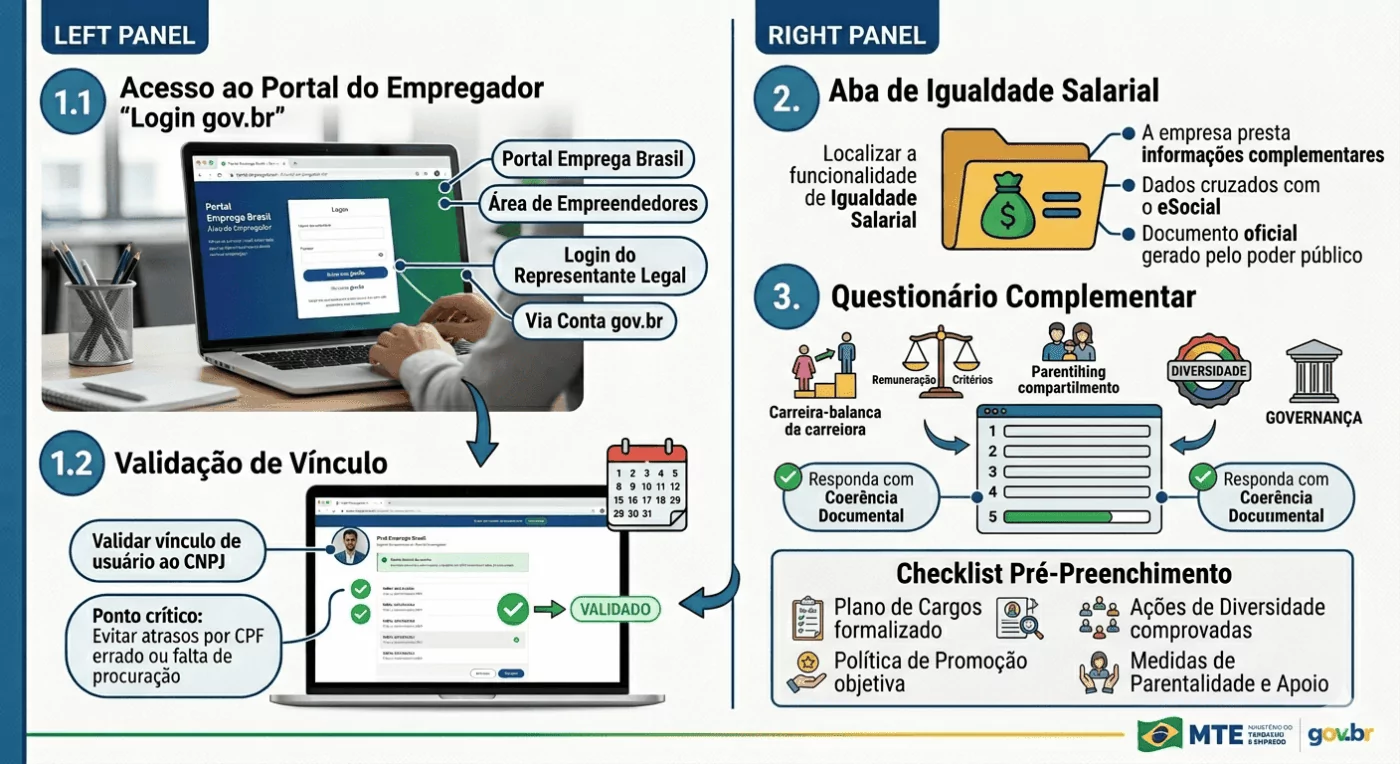
1. Access the employer's portal
The first step is to enter the Emprega Brasil Portal, in the area of employers, with login gov.br of the representative responsible for the company.
In practice, the flow begins on the MTE's employer portal. After logging in, it is necessary to validate that the user is correctly linked to the parent company's CNPJ or to the branches that will be represented in the process. This seems like a simple point, but it often causes delays when access is to the wrong CPF, without the right power of attorney or without an up-to-date link.
If the company has a more decentralized structure, it's worth defining beforehand who will own the process: HR, labor law, the personnel department or compliance. The mistake here is to leave the obligation “ownerless”.
2. Enter the equal pay tab
After accessing the employer's area, the representative must locate the functionality linked to the Equal Pay and Remuneration Criteria.
According to the official guidelines, this is where the company provides the additional information that will be cross-referenced with the data already held in the eSocial. It's not the report itself that the company fills in manually. What it does in the system is feed the complementary base for the government to consolidate the official document.
This detail is important because it avoids a false expectation of “editing the report”. The report is generated by the government. What the company controls is the quality of the information before it is issued.
Read also: All about INSS for entrepreneurs
3. Answer the supplementary questionnaire
After identification in the system, the representative must answer the supplementary questionnaire required by the MTE. The official FAQ itself states that, after identification, those responsible must answer 5 questions.
These questions deal with remuneration criteria and practices related to diversity, the promotion of women, shared parenting and internal governance. Here, it's not just about filling them in. It's filling them in with documentary coherence.
The best way is to validate beforehand:
- whether there is a formalized job and salary plan
- whether there is an objective promotion and advancement policy
- whether the company adopts diversity actions with practical evidence
- whether there are measures to support parenting and share responsibilities
- whether institutional discourse matches HR practice

Optimize your company's personnel management:
Discover our Financial BPO solutions!
What is the salary transparency report?
O salary transparency report stems from the Law 14.611/2023, which reinforced equal pay and remuneration criteria for women and men. In practice, the rule created a transparency mechanism for companies with 100 or more employees.
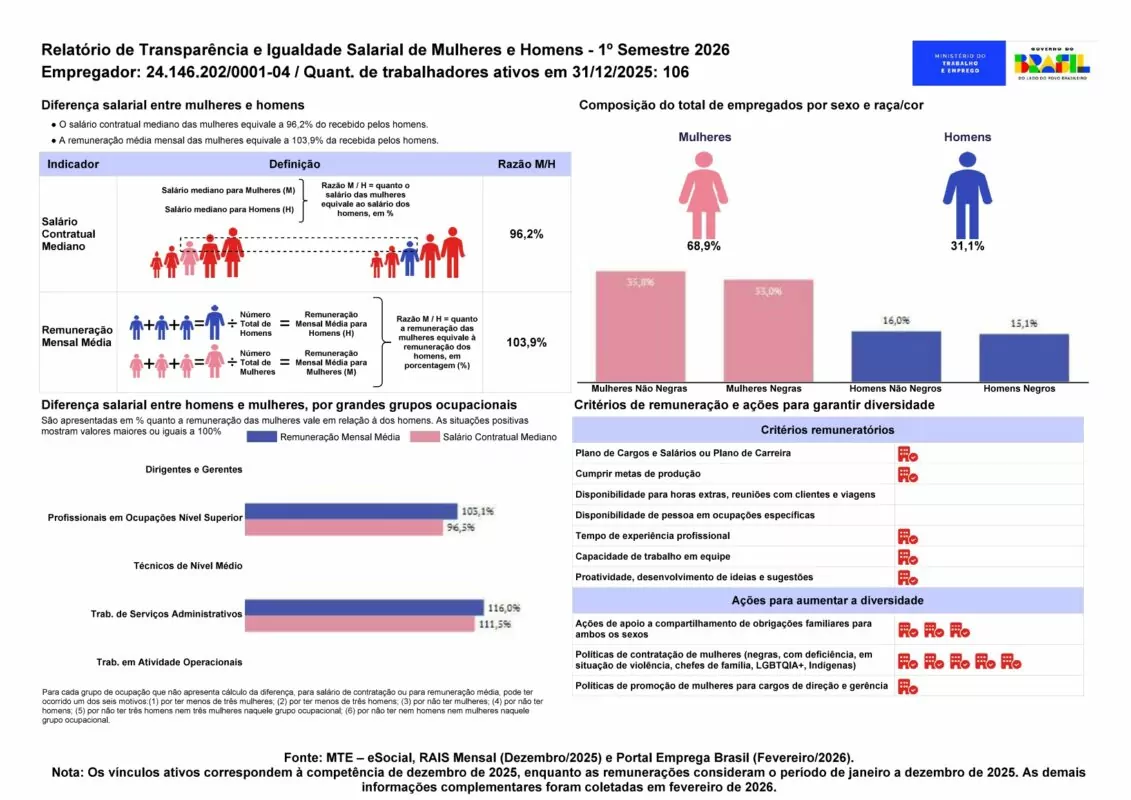
The report is not a free document, put together “the company way”. It is drawn up by the public authorities based on two layers of information.
The first comes from the data already provided by the employer to the eSocial, including salaries, remuneration and workforce composition. The second comes from the complementary information provided by the company in the specific equal pay tab in the Emprega Brasil Portal, These include the existence of a job and salary plan, promotion criteria, incentives to hire women and initiatives to support the sharing of family responsibilities.
In other words: the government cross-references the registration base, remuneration base and complementary answers to generate a picture of the company. This changes the game because it reduces room for improvisation, increases comparability and facilitates inspection.
What changed in practice in 2026
The most important point in 2026 was not a “new law”, but the operational maturity of the model. The process became more integrated, more recurrent and more exposed.
The dates have become a management routine
The rule already provided for publication every six months, but now the process is clearly paced. The company needs to organize itself for two cycles a year.
First semester
In 2026, additional data had to be sent by February 28th. The report was made available on Emprega Brasil in March and the deadline for publication, which was March 31, was extended by the MTE to April 6th, 2026.
Second semester
According to the ordinance that regulates the subject, the flow is repeated with the provision of complementary information in August and published in September.
This requires an internal calendar, ownership of the process and prior validation. Those who leave it to the last week turn compliance into an operational crisis.
Inspection has become more objective
The MTE has already officially announced that it is monitoring and inspection of compliance. In addition, the regulation provides for notification by the Labor Inspectorate and use of the Electronic Workplace Domicile (DET) in the communication flow.
In executive language: risk is no longer abstract. There is a digital trail, structured data and a formal collection channel.
Consequences of non-compliance
The cost of delay or omission is not just symbolic.
By Law 14.611/2023, failure to comply with the obligation to publish the report can lead to administrative fine of up to 3% of the payroll, limited to 100 minimum wages, without prejudice to other sanctions applicable to cases of wage discrimination.
In addition, the company is on a path to greater friction with inspectors and may have to respond to formal notices, including demands for an action plan within a defined timeframe.
There is also a indirect effect that CFOs and CEOs know wellWhen a labor issue enters the non-compliance zone, it begins to contaminate due diligence, contract renewals, processes with major clients, audits and regularity analyses. The loss of certificates or obstacles in contracting processes is not the express penalty of the law, but it is a plausible operational outcome when the company accumulates liabilities and regulatory exposure. This is an inference of management risk, not a literal command of the law.


Spreadsheet
Employee in the Company
The biggest risk is reputational
The fine hurts. But for many companies, the most expensive damage is another: the erosion of trust.
When the salary transparency report if the company has no narrative, plan or governance, the market interprets this as disorganization, not as a legal detail. And today this interpretation is spreading fast.
Employer brand enters the firing line
Candidates consult Glassdoor, The cost of attraction rises if the company is poorly positioned on sensitive topics and shows no reaction. If the company appears to be poorly positioned on a sensitive issue and shows no reaction, the cost of attraction goes up.
Retention also worsens
The publication of the report triggers internal comparison. Without clear criteria, there are noises between areas, a sense of injustice and a loss of trust in leadership. The result can be an increase in turnover, a drop in engagement and difficulty in sustaining the meritocracy discourse.
The market demands coherence
Companies want to be seen as modern, inclusive and well-managed. But reputation doesn't accept discourse without process. When remuneration practices seem opaque, inconsistency weighs more heavily than the institutional message.
For top management, the point is simple: labor reputation has become a business variable.




Conclusion
O salary transparency report should not be treated as a file to download and publish at the end of the deadline. In 2026, it already operates as a test of management maturity, data consistency and reputational preparedness.
Compliance does not go hand in hand with improvisation. A company that enters the process without a prior audit, without governance and without an action plan runs three risks at the same time: a fine, inspection and public scrutiny. And in practice, the cost of making a mistake almost always exceeds the cost of getting the house in order first.
CLM Controller: technical support to reduce real risk
CLM Controller acts as a partner for companies that need to transform regulatory obligations into a secure process. This includes support in labor compliance, prior auditing of data and remuneration criteria, executive reading of risks, structuring of action plans and alignment between HR, legal and leadership. On issues like this, legal certainty doesn't come from a quick response. It comes from method, consistency and correct execution.