




Tax cashback will be one of the main new features of the consumption tax reform. The mechanism will allow low-income families to receive a refund of part of CBS and IBS paid for the purchase of goods and services.
The proposal is to reduce the tax burden on lower-income households, since these families typically spend a larger portion of their budget on food, electricity, gas, water, transportation, and other essentials.
However, the tax cashback program will not work like the points or cashback programs offered by banks and stores. It will be a public benefit, calculated based on the taxes levied on a household’s consumption.
In this article, you'll learn who is eligible, which taxes will be refunded, how the government will identify eligible purchases, and when the system will go live.
What is a tax refund?
Cashback literally means “money back.”.
In the case of the Tax reform, cashback will be a refund of a portion of the new consumption taxes:
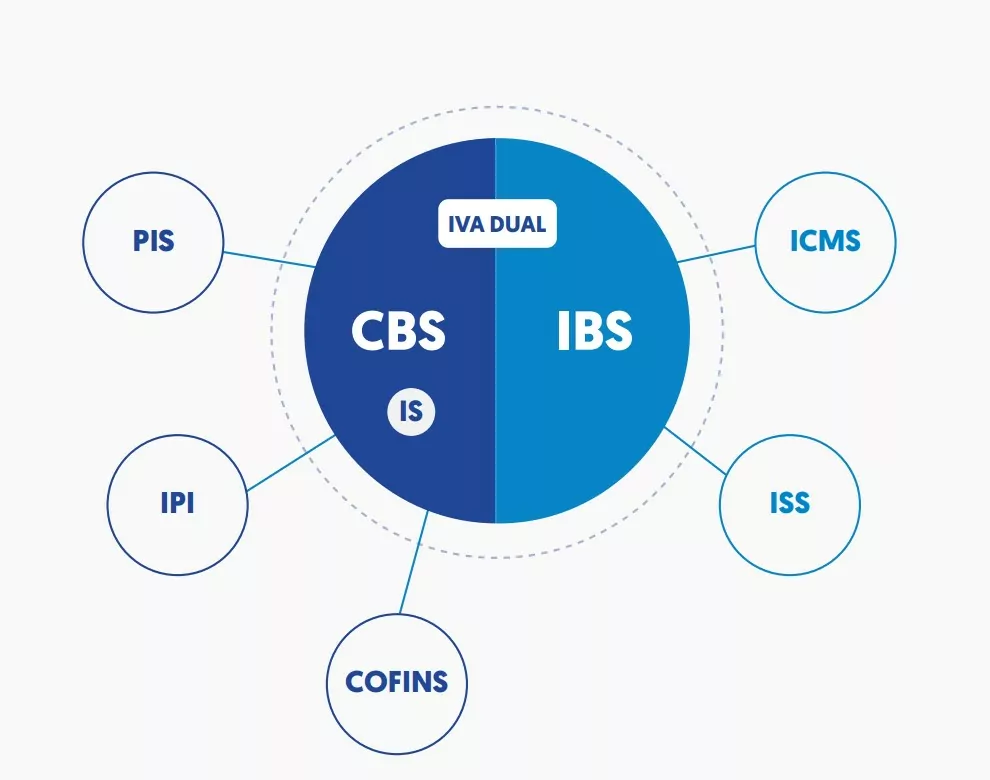
- CBS, Goods and Services Tax, under federal jurisdiction;
- IBS, Goods and Services Tax, administered by states and municipalities.
These two taxes will gradually replace current taxes, such as PIS, Cofins, ICMS, and ISS.
The CBS will go into effect in 2027. The IBS, on the other hand, will begin its transition in 2029, with full implementation of the new system scheduled for 2033.
The goal of the cashback program is to make consumption taxes less unequal. Instead of offering a general tax cut for the entire population, the system will return a portion of the amount paid directly to low-income families.
Who is eligible for the tax cashback?
The benefit will be provided to families who meet the requirements established by the Complementary Law No. 214/2025.
To participate, you will need to:
- be registered in the Federal Government’s Single Registry for Social Programs, the CadÚnico;
- have a monthly household income of up to half the minimum wage per person;
- live in Brazil;
- have a valid CPF number.
The family should be automatically added to the system, without the need to submit a specific request.
The cashback will be paid to the head of the household registered in CadÚnico, but purchases made by all family members may be taken into account, provided they are linked to their respective CPFs.
How do you calculate per capita income?
Income per person, also known as per capita income, is calculated by dividing the total family income by the number of family members.
For example:
A family of four has a total monthly income of R$ 2,400.
In that case:
R$ 2,400 ÷ 4 people = R$ 600 per person.
Since the limit will be up to half the minimum wage per participant, eligibility will depend on the amount of the minimum wage in effect during that period.

Complete Guide to
Tax reform
How much will be refunded?
Refund percentages will vary depending on the product or service purchased.
Essential services and cooking gas
The law provides for the refund of:
- CBS's 100%;
- IBS 20%.
These percentages will be applied to the taxes levied on the following expenses:
- a gas cylinder weighing up to 13 kilograms;
- residential electricity;
- water supply;
- sewage system;
- piped gas;
- telecommunications services, such as telephone and internet services.
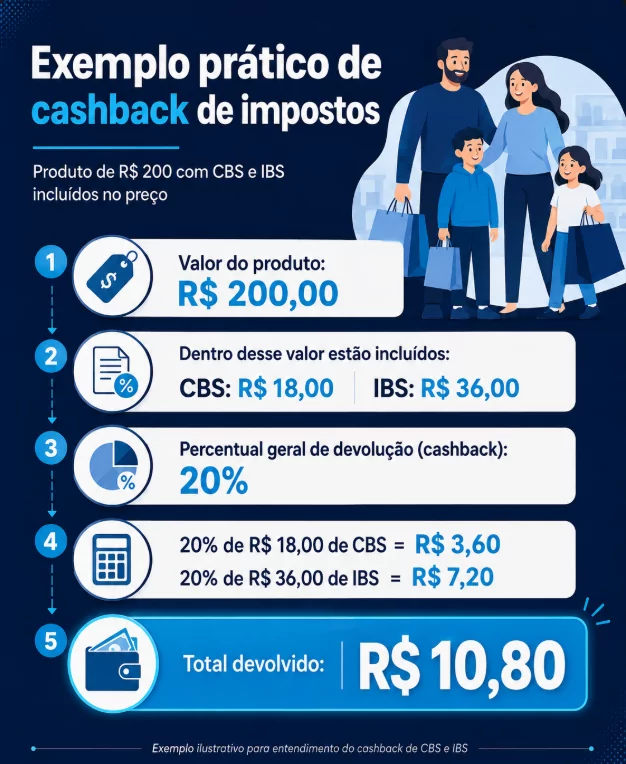
Therefore, this does not mean that the consumer will receive a refund of 100% of the bill or purchase amount. The 100% refund will apply only to the portion corresponding to the CBS.
For all other products and services eligible for cashback, the minimum refund will be:
- CBS's 20%;
- IBS 20%.
The federal government, states, and municipalities may approve higher percentages for their share of the tax, including by establishing different tax rebates based on household income.
A practical example of cashback
Will it be necessary to ask for the CPF number on the receipt?
Tracking the family's purchases will be an important part of the system.
Tax documents linked to the CPF numbers of household members may be used to calculate consumption and the amount of taxes to be refunded.
For this reason, requesting that the CPF number be included on the invoice is likely to become even more important for beneficiary families.
In addition to enabling the identification of transactions, this system aims to encourage:
- the proper issuance of invoices;
- the formalization of sales;
- the reduction of tax evasion;
- combating unfair competition;
- strengthening tax compliance.
The law stipulates that cashback payment procedures must prioritize mechanisms that encourage the issuance of tax documents.
How will the money be refunded?
For services billed on a recurring basis, such as electricity, water, sewer, and natural gas, the refund may appear directly on the consumer's bill.
This means that the benefit can be applied as a discount or credit on the invoice itself.
For all other purchases, the government must determine the amount due and transfer the funds to the financial institutions.
The law stipulates that, after the funds have been calculated, the government will have up to 15 days to transfer the amounts to the banks. Financial institutions will then have an additional 10 days to disburse the funds to the beneficiaries.
The exact method of payment—which may involve a bank account, a digital account, or another payment method—will still depend on the system’s operational rules.
Will the cashback be deposited immediately after each purchase?
Not necessarily.
Despite the name “cashback,” the system is not expected to work exactly like commercial programs in which a percentage is credited to the customer’s account immediately after the purchase.
The government may compile the family's tax information for a specific period, calculate the amount of taxes actually paid, and then issue a refund.
The frequency, the calculation process, and the channels for accessing the information are still subject to regulation and the implementation of the Tax Reform’s technological platforms.
Will all purchases qualify for cashback?
No.
Products and services subject to a zero CBS and IBS tax rate will not result in a refund, as no tax has been paid that could be refunded.
This is the case for several products included in the National Basic Food Basket, such as rice, beans, milk, meat, French bread, eggs, and other items specified in the legislation.
There will also be no cashback on products subject to the Selective Tax.
The Selective Tax will be levied on certain products considered harmful to health or the environment. Collection will begin in 2027.
Will the cashback be deposited immediately after each purchase?
Not necessarily.
Despite the name “cashback,” the system is not expected to work exactly like commercial programs in which a percentage is credited to the customer’s account immediately after the purchase.
The government may compile the family's tax information for a specific period, calculate the amount of taxes actually paid, and then issue a refund.
The frequency, the calculation process, and the channels for accessing the information are still subject to regulation and the implementation of the Tax Reform’s technological platforms.
Will all purchases qualify for cashback?
No.
Products and services subject to a zero CBS and IBS tax rate will not result in a refund, as no tax has been paid that could be refunded.
This is the case for several products included in the National Basic Food Basket, such as rice, beans, milk, meat, French bread, eggs, and other items specified in the legislation.
There will also be no cashback on products subject to the Selective Tax.
The Selective Tax will be levied on certain products considered harmful to health or the environment. Collection will begin in 2027.
Are a basic food basket and cashback the same thing?
No. They are different mechanisms.
For the basic food basket subject to a zero tax rate, the product will already be sold without the CBS or IBS taxes applied. Therefore, consumers will not need to pay the tax and then receive a refund.
With cashback, the tax is included in the price of the purchase or service. Subsequently, a portion of that tax will be refunded to the beneficiary family.
In a nutshell:
- zero tax rate: no tax is charged;
- cashback: Tax is charged, and a portion is refunded.
New exemption calculator
IR
When does the tax refund take effect?
The timeline outlines the implementation of the new taxes.
Refunds related to CBS will begin in January 2027.
Cashback related to the IBS, on the other hand, will begin in 2029, along with the transition from the ICMS and ISS to the new state and municipal tax.
In 2026, Brazil will be in the initial testing phase of the Tax reform. Companies already need to adapt their tax documents and systems to include the fields related to the CBS and the IBS, even though the actual collection of the new taxes is still being implemented.
Will there be a limit on the cashback amount?
The law allows the calculation to take into account consumption limits that are consistent with the family's profile and income.
This is important to prevent purchases that are too large—and inconsistent with the household’s consumption—from resulting in excessive returns or being used improperly.
The government will be able to analyze data such as:
- family income;
- number of members;
- tax documents issued;
- nature of the products and services;
- average consumption patterns.
The detailed rules for calculation, monitoring, and limits will depend on the operational regulations.
Can the benefit be canceled?
The family may stop receiving cashback if it no longer meets the program's requirements.
This can happen, for example, when:
- the household income exceeds the limit;
- the CadÚnico registration is out of date;
- the person responsible ceases to reside in Brazil;
- the CPF becomes invalid;
- if any incorrect or inconsistent information is identified.
Therefore, it is important to keep your CadÚnico information up to date and to regularly check the status of family members’ CPF numbers.
Could cashback rates increase in some states?
Yes.
Complementary Law No. 214/2025 established minimum refund percentages, but authorized the federal government, the states, the Federal District, and the municipalities to set higher percentages for the portion of the tax that belongs to them.
A state, for example, may decide to return a higher percentage of its share of the IBS to families in a certain income bracket.
This means that the amount of the benefit may vary depending on the legislation enacted by each state.
What will change for businesses?
Although cashback is intended for consumers, its implementation will also affect businesses.
The mechanism’s effectiveness will depend on the quality of the information provided on invoices. Errors in the consumer’s CPF number, product classification, or the calculation of the CBS or IBS may hinder the determination of the refund.
Companies will need to review:
- issuing invoices;
- the consumer's CPF number;
- product and service registry;
- tax classification;
- calculation of CBS and IBS;
- integration between ERP, payment methods, and tax systems;
- sales cancellation and return procedures;
- storage and transmission of tax documents.
It will also be necessary to provide guidance to teams in the areas of cashier services, customer service, billing, finance, and technology.
An important point is that the cashback should not be funded directly by the merchant. The company will calculate and collect taxes according to standard rules, while the refund will be administered by the government.

Why was cashback created?
Consumption taxes disproportionately affect low-income households.
A family with a lower income typically spends almost its entire budget on basic goods and services. Families with higher incomes, on the other hand, are able to save and invest a larger portion of their income.
Since consumption taxes are included in prices, lower-income households end up allocating a larger portion of their income to indirect tax payments.
Cashback aims to correct part of this inequality by returning tax refunds in a more targeted manner.
What are the challenges facing the system?
Despite its potential to reduce tax inequality, the implementation of the cashback program will face significant challenges.
Among them are:
- integration between CadÚnico, Internal Revenue Service e IBS Steering Committee;
- correct identification of the members of each family;
- processing of millions of tax documents;
- definition of payment methods;
- personal data protection;
- fraud prevention;
- services for people without bank accounts;
- updating company systems;
- clear communication for beneficiaries.
Proper operation will depend on a technological infrastructure capable of securely cross-referencing tax and social data.
How can consumers prepare?
Families who may be eligible for the benefit should start taking care of a few things:
- Keep CadÚnico up to date.
- Verify that the CPF numbers of all family members are in good standing.
- Request that the CPF be included on invoices.
- Keep receipts for purchases and bills for essential services.
- Follow only the government's official channels.
- Be wary of messages that charge fees to release your cashback.
Since enrollment should be automatic, any charges for registration, early access, or unlocking the benefit may indicate an attempted scam.
How can companies prepare?
For businesses, preparations should begin before the cashback program actually goes into effect.
It will be necessary to identify the changes brought about by the tax reform, update systems, and ensure that tax documents are issued with accurate information.
Among the key measures are:
- assess whether the ERP system is ready for CBS and IBS;
- review the tax records for products and services;
- test the issuance of tax documents;
- validate the consumer's CPF number;
- train the teams in charge;
- comply with the regulations of the Federal Revenue Service and the IBS Management Committee;
- run simulations of prices, taxes, and cash flow;
- Review the integration with banks and payment methods.
Compliance should not be viewed solely as an obligation of the tax department. It involves technology, finance, accounting, customer service, sales, and data management.
Conclusion
Tax rebates will be one of the main social tools of the tax reform.
The system will allow families registered with CadÚnico and with an income of up to half the minimum wage per person to receive a refund of a portion of the CBS and IBS taxes paid on their purchases.
Repayment will begin in 2027 for CBS and in 2029 for IBS. Essential services, such as water, electricity, gas, and telecommunications, will have higher repayment percentages.
For consumers, it will be essential to keep their CadÚnico and CPF up to date, as well as to provide their CPF when making purchases.
For companies, the challenge will be to ensure that invoices are issued correctly, adapt their systems, and provide reliable information to the tax authorities.
The tax reform will require a significant transformation of tax and financial processes. Proactively making these adjustments will be essential to reduce risks, avoid errors, and operate safely under the new tax system.
Is your company ready for the changes brought by the Tax Reform? CLM Controller helps you review tax processes, systems, records, and the financial impacts of the CBS and IBS. Talk to our experts and prepare your business for the new tax model.
Upgrade your finances:
Talk to us!
Frequently Asked Questions About Tax Cashback
Will people who aren't registered with CadÚnico receive cashback?
Under the current rules, no. The benefit will be provided to low-income families registered in CadÚnico who meet the other legal requirements.
Will I need to register?
Enrollment should occur automatically based on information from CadÚnico. However, the family's information must be up to date.
Will the cashback be based on the total purchase amount?
No. The refund will be calculated based on the CBS and IBS included in the price, not on the total amount paid by the consumer.
Will the money be refunded at the time of purchase?
For some essential services, the refund may appear directly on the bill. For all other purchases, the amount will be calculated and transferred at a later date.
Will it be mandatory to include the CPF number on the receipt?
The law requires the use of tax documents linked to the CPF to identify a household’s spending. Therefore, providing your CPF number is important for calculating your tax refund.
Will there be cashback on basic food basket items?
Products with a zero tax rate will not generate cashback, as there will be no CBS or IBS to be refunded.
Will companies pay cashback to customers?
Not directly. The refund will be handled by the government. The company’s responsibility will be to issue tax documents correctly and collect the applicable taxes.
Will the cashback program start in 2026?
No. The initial testing and adaptation phase will take place in 2026. The CBS cashback program begins in 2027, and the IBS cashback program begins in 2029.
