
Starting in September 2026, business owners in the Simples Nacional service providers face two simultaneous and unrelated changes, but which fall in the same month:
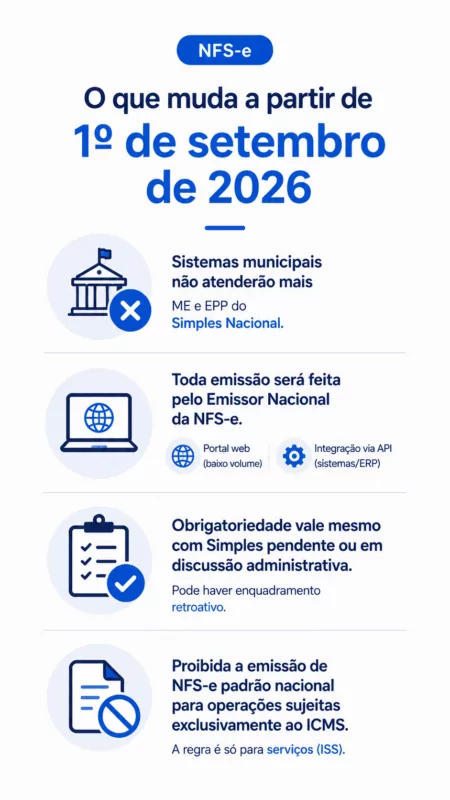
- The National NFS-e will be mandatory starting September 1, 2026, replacing municipal issuers.
- New window for opting into the Simples Nacional system for 2027, from September 1 to 30, 2026, with a decision to be made regarding the traditional or hybrid IBS/CBS regime.
Anyone who misses these deadlines risks being barred from issuing invoices, facing problems collecting payments from corporate clients, or being excluded from the Simples Nacional program in 2027. See below for full details, including step-by-step instructions and fine amounts.
Mandatory National NFS-e: What Changes in Practice
Who is affected
Every microenterprise (ME) and small business (EPP) that has opted for the Simples Nacional tax regime and provides services subject to an invoice. Self-employed professionals and independent contractors who already use the specific exemption regime are required to comply starting on August 1, 2026, one month before the other companies.
MEIs are not affected by this specific change: they already use the National NFS-e since 2023.
Why is this change happening?
The National NFS-e replaces more than 5,000 different municipal formats with a single federal standard, in line with the fiscal digitization approach that also underpins the Tax reform. Over time, this database feeds into what is known as “assisted assessment,” in which the government itself pre-calculates taxes based on the documents issued.
Step-by-Step Guide to Getting Ready
- Check to see if your current invoicing system (ERP or invoicing platform) is already integrated with the National NFS-e API. If you don't have it, you'll need to migrate or update before September.
- Access National NFS-e Portal with your Gov.br account and register in advance, even if it isn't yet mandatory for you (through August, registration is optional for ME/EPP).
- Conduct emissions tests before September. Issue some test invoices in the national environment to identify errors in the configuration of the ISS tax rate and service code (NBS/LC 116) and municipal registration.
- Check for any outstanding registration issues at city hall. The ISS tax rate still depends on municipal settings replicated in the national system—an outdated record causes an error during issuance.
- Train the team responsible for issuing invoices and review internal tax reconciliation processes.
- Talk to the accounting department about the accounting integration, since ISS, PIS, COFINS, CSLL, and IRPJ may now be calculated collectively within the tax document itself.


Spreadsheet
Simples taxes
What happens if the company doesn't adapt in time?
If a company is unable to issue invoices as of September 1, it will be in violation of tax regulations and:
- It is prohibited from issuing invoices to customers who require an invoice (most B2B companies).
- It may be fined for failure to comply with an ancillary obligation.
- You are subject to fines for failing to issue a tax document—which vary by state/municipality but follow the same rationale currently applied to the failure to issue an NF: Under the Simples Nacional system, penalties typically range from 10% to 30% of the value of the unrecorded transaction, and may reach higher amounts in cases of repeat offenses or where tax evasion is established. More serious cases (willful omission) may involve higher percentages and, in extreme situations, criminal consequences.
- Access to indirect benefits, such as certificates of no outstanding debt and eligibility to participate in public bids, is also lost.
New Window for Opting into Simples Nacional (Tax Reform)
This change is different from the NFS-e, but it falls in the same month—and that’s why September 2026 will be a critical decision-making period for those enrolled in the Simples tax regime.
The end of adoption in January
Historically, the decision to opt into the Simples Nacional tax regime was made in January. With the Consumption Tax Reform (IBS/CBS), that window no longer exists. From now on, the decision will be made every six months and in advance.
How the new September window works
- Deadline: The decision to use the Simples Nacional tax regime for operations in 2027 must be made between September 1 and 30, 2026.
- Effective Date: Even if you opt in during September, the classification does not take effect until January 1, 2027.
- Additional decision during the same period: The company also decides whether it wants to collect the IBS and CBS within the single Simples tab (traditional system) or externally, under the ordinary regime (hybrid system).
- Repentance: You can cancel the option you selected in September until the last day of November 2026.
- Second chance: Those who do not opt for the hybrid plan in September may do so in March 2027, effective as of the second half of that year.
- Companies established between October and December 2026: The choice made at the time of CNPJ registration is valid for two periods—it applies to the remainder of 2026 and all of 2027.
- This new system This does not apply to MEI: Those who choose SIMEI will continue to make their decision in January, as has always been the case.
Why the Choice Between a Traditional and a Hybrid System Matters
Companies that sell to other companies (B2B) should carefully evaluate:
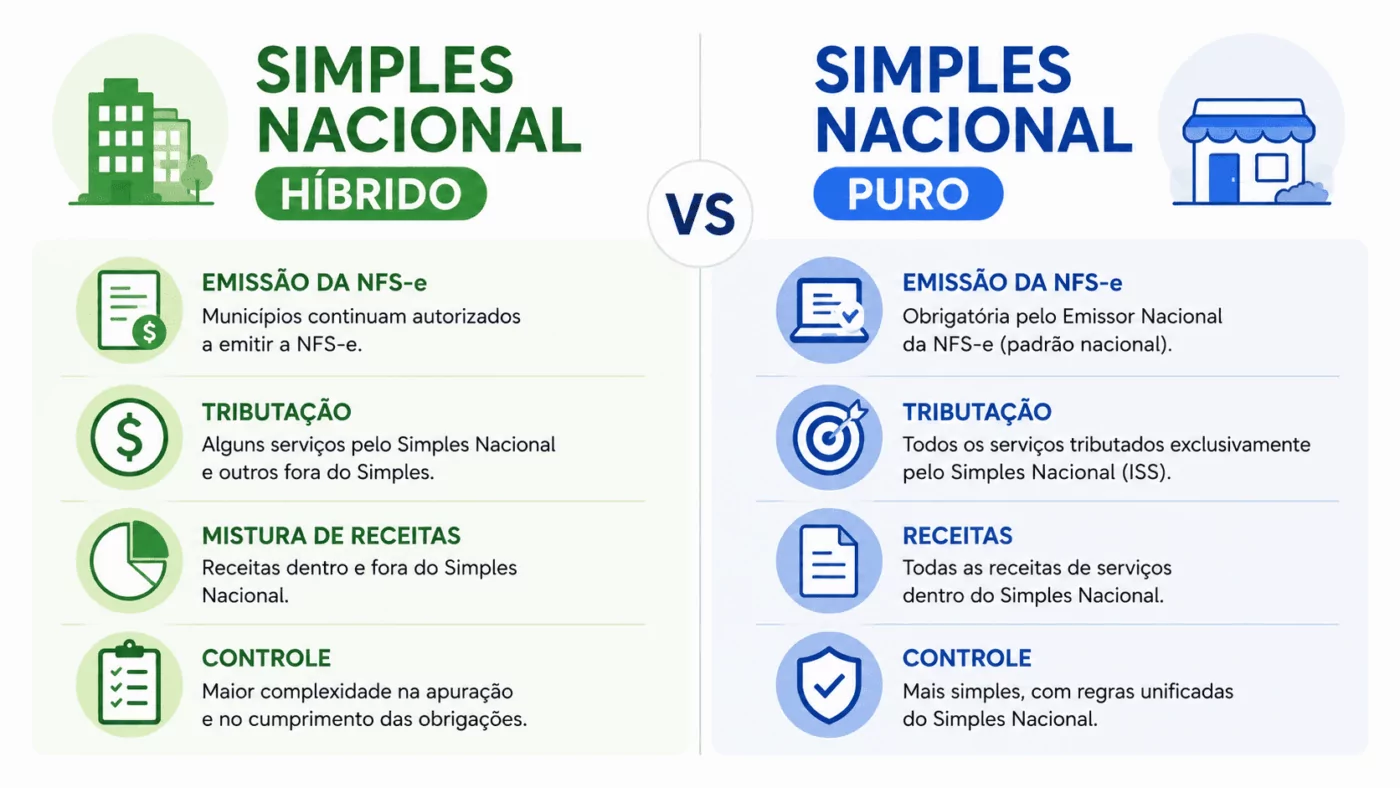
- In hybrid system, the company will now generate IBS/CBS tax credits at the full rate for business customers, which may make the service more competitive from the buyer’s perspective, but typically results in a higher tax burden for the service provider.
- In traditional tax system (Simples Puro), the service provider's tax burden tends to be lower, but the tax credit generated for the corporate customer is reduced, which can work against the company in B2B negotiations.
There is no single answer: the choice depends on the mix of clients (individuals vs. businesses), the service margin, and the client’s sensitivity to the tax credit. It is recommended to run scenario simulations before September.
Step-by-Step Guide for the September 2026 Window
- Settle any outstanding tax issues before August. A Internal Revenue Service It has moved up the exclusion notices to early 2026; only those who are current on their payments have the right to choose between the traditional or hybrid plan.
- Build the company's customer profile (percentage of B2B vs. B2C revenue) to assess the impact of tax credit generation.
- Simulate both scenarios (traditional vs. hybrid) in terms of accounting, taking into account margin, tax burden, and the effect on pricing.
- Visit the Simples Nacional Portal in September 2026 to formalize the decision regarding both eligibility for the program and the choice between IBS and CBS.
- Mark your calendar for the November 2026 deadline if you wish to withdraw from the choice you made in September.
- Review the pricing of B2B contracts that mature or are renegotiated at the end of 2026, depending on the chosen arrangement.

Tax outsourcing
The strategic solution for companies
R Factor: Extra Attention for Service Providers
In addition to the two changes in September, Simples Nacional service providers should be aware of the R Factor, which has become stricter: a company must demonstrate that at least 30% of its gross revenue corresponds to payroll expenses in order to remain in the most advantageous brackets of Annex III (rather than moving to Annex V, which has higher tax rates). Companies with outstanding tax liabilities may also be automatically disqualified without prior notice—yet another reason to resolve their tax situation before the September filing window.
This particularly affects clinics, agencies, and providers of professional services that have a low payroll-to-revenue ratio.
Quick Guide: What to Do and When
| Period | Action Required |
|---|---|
| Through August 2026 | Test the issuance of NFS-e in the national environment (participation is still optional for microenterprises and small businesses); resolve outstanding tax and registration issues |
| August 1, 2026 | National NFS-e Becomes Mandatory for Independent Professionals and Self-Employed Individuals with Specific Exemptions |
| September 1, 2026 | National NFS-e is mandatory for all micro-enterprises (ME) and small businesses (EPP) under the Simples tax regime that provide services; municipal systems are deactivated for this group |
| September 1–30, 2026 | Window for opting into the Simples Nacional system for 2027 + choice between the traditional or hybrid IBS/CBS system |
| Through the last day of November 2026 | Deadline for withdrawing from the option selected in September |
| January 1, 2027 | New Simples classification and chosen IBS/CBS regime officially take effect |
| March 2027 | Second window for changing the IBS/CBS payment regime (effective as of the second half of 2027) |
Conclusion
September 2026 marks two decisions that cannot be made at the last minute: the technical adaptation to the National NFS-e and the choice of the tax regime that will apply to the company’s entire operation in 2027. Companies that reach that date without having their tax affairs in order, without simulating scenarios (traditional vs. hybrid) and without testing invoice issuance in the new system run the risk of ceasing to generate revenue, paying avoidable fines, or entering 2027 under the wrong tax regime—a decision that, once made, can only be revised in March of the following year.
The common thread between the two changes is that both require a case-by-case technical analysis: the impact of the hybrid system depends on a company’s mix of B2B and B2C customers, and the migration to NFS-e depends on the integration of its management system with the national API. This is not a decision to be made without data.
That's where the CLM Controller comes in. We are an accounting firm specializing in helping domestic and international companies safely navigate exactly this type of regulatory change—from corporate structuring to day-to-day tax, accounting, and payroll matters. If you want to:
- simulate traditional vs. hybrid operating scenarios for your operation before the September window;
- ensure that your company is technically ready for the National NFS-e without any disruption to billing;
- or simply having an accounting partner who keeps track of these changes for you;
Talk to the team at CLM Controller and understand how these changes apply specifically to your business.

Upgrade your finances:
Talk to us!
Frequently asked questions
Does the National NFS-e apply to those who are not enrolled in the Simples Nacional program? For now, the September 2026 deadline applies specifically to microenterprises (ME) and small businesses (EPP) under the Simples Nacional tax regime. Companies under the Presumed Profit and Actual Profit tax regimes follow the rules of their respective municipalities, although many are already voluntarily transitioning to the national standard.
Do MEI business owners need to be concerned about these changes? Not with NFS-e (which has been using the national standard since 2023) nor with the new option window in September (it continues to opt for SIMEI in January).
Can I continue to issue invoices through the city government's system after September? No. After the deadline, the municipal system stops issuing invoices for ME/EPP under the Simples Nacional program.
What happens if I miss the September deadline to opt for the Simples tax regime in 2027? The company will no longer be eligible for the simplified tax regime as of January 2027 and will have to operate under a more burdensome tax regime (Presumed or Actual Profit), with the possibility of reapplying only during future enrollment periods.
What is the practical difference between the traditional and hybrid regimes under Simples? Under the traditional system, IBS and CBS are included within the single Simples tax bracket, with a generally lower tax burden but without generating a full tax credit for corporate clients. Under the hybrid system, IBS and CBS are collected separately, generating a tax credit for corporate clients but typically increasing the service provider’s tax burden.